
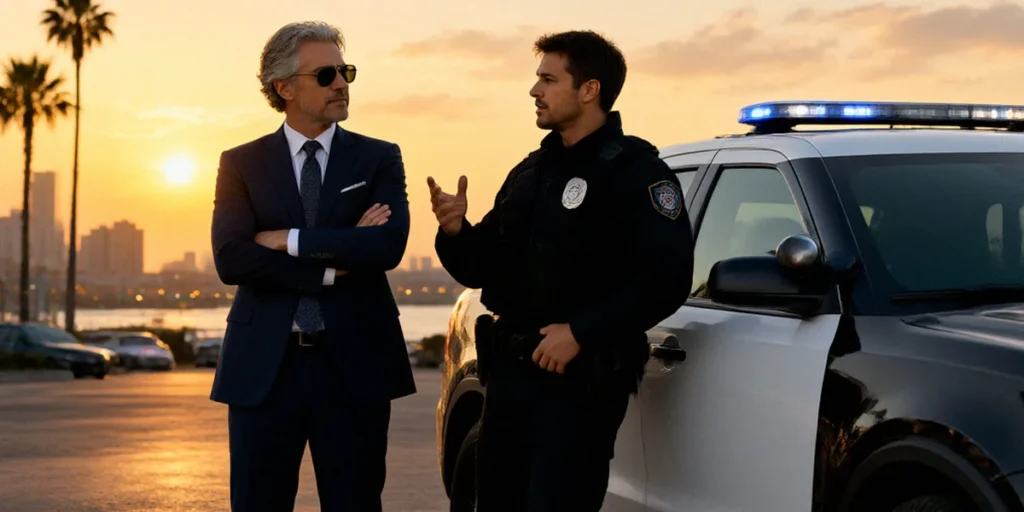
The Buddy-Cop Formula: Why Mismatched Duos Work
Picture the scene: a battered sedan idles outside a grim South London estate. Inside, one detective studies a case file, highlighter in hand, while the other slouches against the window, cold coffee in one fist, muttering about procedure being “for people who can’t think on their feet.” They argue. They sulk. And then, because the job demands it, they get out of the car and solve the case together. We have seen this scene a hundred times, in cinemas and on streaming services, and somehow we never tire of it. Why does the mismatched duo remain the most reliable engine in crime fiction? We think the answer says as much about us as it does about the genre.
The DNA of the Buddy-Cop Dynamic

Strip any buddy-cop story back to its chassis and you find three components: contrast in methods, a shared goal, and forced proximity. Take one away and the machine stalls. The template was arguably perfected by Lethal Weapon (1987), written by Shane Black, which paired a suicidal loose cannon with a weary family man approaching retirement. Every mismatched duo since has been negotiating with that blueprint, whether consciously or not.
UK crime fiction runs on the same DNA. Line of Duty, the BBC police procedural created by Jed Mercurio, gives us officers bound by rank and duty but divided by instinct and ambition, and the friction between them drives entire series. The uniforms change, the accents change, but the wiring is identical.
Opposites Attract (and Annoy)
Contrast is the fuel. One partner follows the rulebook; the other treats it as a suggestion. One talks too much; the other hasn’t spoken since Tuesday. Crucially, the contrast must be in method, not just personality, because method is what generates plot. A by-the-book detective gathers evidence that the reckless one then uses in an unauthorised stakeout. Each needs what the other has, which is why the pairing works even when the people don’t.
The Forced Partnership Trope
Nobody in a good buddy story chooses their partner. They are assigned, transferred, demoted, or blackmailed into it. That lack of choice matters, because it removes the escape hatch. If they could walk away, they would, and there would be no film. The forced partnership is a pressure cooker, and pressure cookers produce either explosions or dinner.
Why Conflict Creates Chemistry
Audiences confuse chemistry with agreement. It isn’t. Chemistry is friction with a shared stake. Two detectives who bicker over everything but would take a bullet for each other generate more electricity than two friends who agree about lunch. The conflict is the courtship, and the case is the excuse.
From Hollywood to the UK: The Formula Across the Pond
American buddy-cop films tend to be loud, fast, and built around spectacle. 48 Hrs. yoked a convict to a cop for 48 hours of mayhem, while Rush Hour turned cultural difference into a punchline delivery system. Britain and Ireland took the same skeleton and dressed it in something drier.
American Excess vs. British Dry Wit
Where Hollywood reaches for explosions, British crime fiction reaches for a raised eyebrow. The humour is deadpan, the violence is often mundane, and the emotional beats arrive sideways. A US duo might resolve a feud during a car chase; a British duo might resolve it over a lukewarm cup of tea in a hospital corridor, which somehow lands harder.
Regional Rivalries as Character Conflict
UK settings hand writers a free source of tension: geography. A Met officer seconded to a rural force, a London detective sneering at provincial policing, a Scottish sergeant paired with an English inspector. These rivalries are real, familiar, and instantly legible to a British audience, which means the conflict needs no explanation and can start in the first scene.
Case Study: Hot Fuzz and the Buddy-Cop Satire
Hot Fuzz (2007), directed by Edgar Wright and set in Gloucestershire, is the sharpest British riff on the genre. It pairs an overachieving London constable with a laid-back rural sergeant, then uses that mismatch to satirise everything from action-movie clichés to small-town English life. It works because it loves the formula even as it skewers it.
Then there’s The Guard (2011), the Irish buddy-cop film starring Brendan Gleeson as a cynical Galway garda forced to work with a straight-laced FBI agent. It is foul-mouthed, melancholy, and proof that the formula travels beautifully when the setting is allowed to shape the characters rather than merely decorate them.
Why Mismatched Duos Mirror Real Detective Work
The formula isn’t purely a narrative invention. Real investigations genuinely rely on pairing officers with different specialities, and the friction that results is often productive rather than destructive.
Specialist vs. Generalist
The Metropolitan Police Service in London routinely staffs murder investigations with a mix of skills: a senior investigating officer setting strategy, a forensic specialist, a family liaison officer, an intelligence analyst. No single detective holds every thread. The mismatched duo is simply a dramatised version of that division of labour, compressed into two people for the sake of screen time.
The Mentor-Rookie Dynamic
Regional forces lean heavily on experience transfer, pairing a veteran with a probationer. The veteran knows the streets, the informants, and which pub landlord lies. The rookie knows the new legislation and isn’t yet cynical enough to cut corners. That gap is a story engine in itself.
When the Mismatch Becomes Personal
Procedural shows like Broadchurch understand that the professional mismatch can become an emotional one. When a detective’s own grief or guilt collides with a partner’s steadiness, the case stops being a puzzle and becomes a reckoning. That is where crime fiction earns its keep.
Writing Your Own Mismatched Duo: Story Prompts and Loglines
If you’re building your own detective duo, our advice is to start with the conflict and work backwards. The case matters less than the crack between your two leads. Our story prompts and loglines categories are full of starting points, and we’re always happy to read yours.
Crafting a Logline That Sells the Conflict
A strong logline names both characters, states the mismatch, and implies the case that will test it. For example:
- A disgraced fraud detective is forced to partner with a psychic fraudster to catch a killer who only targets con artists.
- Two rival Manchester detectives must share a desk when a cold case reopens thirty years after they each thought it was solved.
- A by-the-book firearms officer is paired with a burnt-out negotiator to talk down a hostage-taker who knows them both.
Three Story Prompts to Spark Your Duo
- The Transfer: A London detective is sent to a coastal town and partnered with the only officer who doesn’t want the promotion that comes with solving the case.
- The Reunion: Two former partners, now estranged, are forced back together when their old case file resurfaces with new evidence.
- The Swap: A meticulous forensic accountant and a chaotic undercover officer trade roles for one investigation, with predictably disastrous results.
Avoiding Clichés While Keeping the Fun
The genre is forgiving, but it punishes laziness. Swap the genders, flip who is the rule-follower, make the quiet one the reckless driver. Give each partner a skill the other genuinely lacks. And resist the urge to resolve the tension too early; the audience came for the bickering, not the group hug.
The Enduring Appeal: Why We Keep Watching
Why do we return to this formula again and again, decades after Lethal Weapon first put Riggs and Murtaugh in a car together? The reasons are psychological as much as narrative.
Comfort in Predictability
We know the beats. We know they’ll clash, then bond, then clash again before the final act. That predictability isn’t a flaw; it’s the point. Crime fiction offers a world where chaos is temporary and order is restored, and the mismatched duo is the most reassuring vehicle for that promise.
The Satisfaction of Unlikely Friendship
There’s genuine wish fulfilment in watching two people who shouldn’t get along discover that they can. In a world that feels increasingly tribal, the buddy-cop story insists that difference is an asset rather than a barrier. That’s a hopeful idea, and it’s why the final handshake or shared joke lands every time.
Evolution of the Formula in Modern Crime Fiction
The formula keeps mutating. Sherlock Holmes and Watson remain the ur-text, endlessly rebooted. Modern crime fiction has given us duos of different ages, genders, ethnicities, and moral codes, and the best of them use the mismatch to say something new about class, race, or trauma while still delivering the goods. The chassis holds; the bodywork changes.
FAQ
What makes a good buddy-cop duo?
Contrast in method, a shared goal, and no easy way out of the partnership. If the two characters could simply walk away, the story has no engine.
Which British films best demonstrate the buddy-cop formula?
Hot Fuzz (2007) and The Guard (2011) are the strongest examples, both using regional settings and dry humour to reshape the American template.
How is Line of Duty related to the buddy-cop genre?
Jed Mercurio’s BBC series applies the same DNA, pairing officers with clashing instincts and methods inside a procedural framework, even though it plays the tension far straighter than a traditional buddy film.
Do real police investigations use mismatched partnerships?
Yes. The Metropolitan Police Service and regional forces routinely pair specialists with generalists, and veterans with rookies, because different skills solve different parts of a case.
Where can I find story prompts for my own detective duo?
Our story prompts and loglines categories are built for exactly this, and we welcome submissions from readers developing their own mismatched investigators.
The buddy-cop formula endures because it reflects something we genuinely need: the belief that connection across difference is possible, and that two people who irritate each other can still save the day together. Whether it’s Riggs and Murtaugh, Angel and Butterman, or Holmes and Watson, we keep watching because we keep hoping. Tell us your favourite mismatched duo, and we’ll add them to our list.