
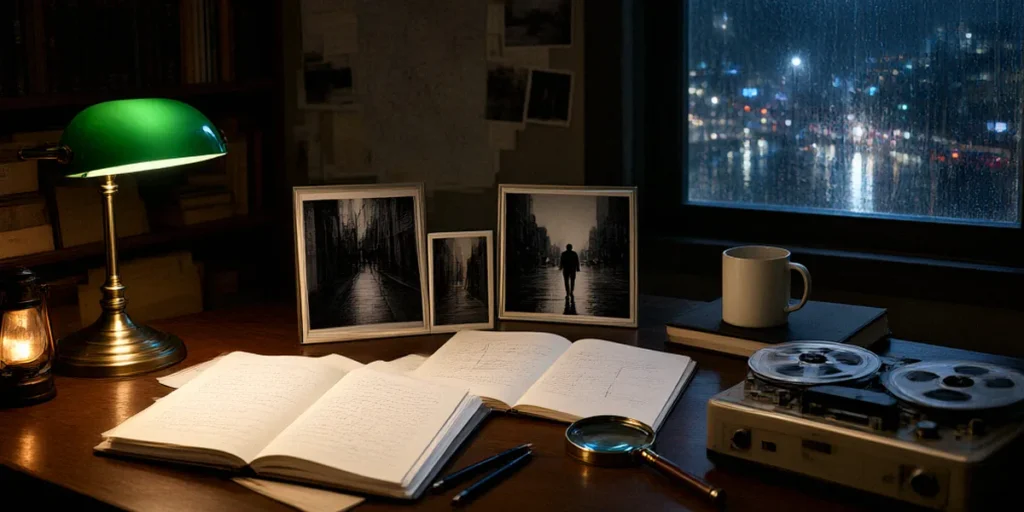
50 Crime Story Prompts to Beat Writer’s Block
We know the feeling. You sit down to write, the cursor blinking on a blank page, and every idea you have feels either too familiar or too thin to carry a whole story. Whether you’re crafting a gritty UK noir set in the rain-slicked backstreets of Glasgow or a buddy cop caper with more banter than bullets, the hardest part is often simply getting the first idea down. That’s where these 50 crime story prompts come in. They’re designed to get the creative gears turning, bypass the inner critic, and give you a starting point you can run with. Pick one, twist it, and see where it takes you.
Why Crime Fiction Prompts Work

Prompts work because they give your brain a specific problem to solve rather than an endless void to fill. Instead of asking “what should I write about?”, you’re asking “how would this detective duo handle a body found on the London Underground?” That shift from open-ended anxiety to concrete puzzle-solving is what unlocks momentum. It’s the same principle behind the writers’ rooms of shows like the BBC’s Line of Duty, where a tight premise and a set of constraints produce relentless, focused drama. Classic buddy cop films such as Hot Fuzz also thrive on a simple, high-concept setup — big-city cop, sleepy village, escalating chaos — that gives the comedy and action somewhere to live.
The Psychology of Creative Blocks
Creative blocks are rarely about a lack of ideas. More often, they’re about perfectionism. We freeze because the first sentence we imagine isn’t good enough, so we write nothing at all. A prompt sidesteps that trap by lowering the stakes: you’re not writing your masterpiece, you’re just responding to a scenario. It gives you permission to write something messy and provisional, which is exactly what a first draft should be.
How Constraints Boost Creativity
Counterintuitively, limits make us more inventive. Tell a writer “write a crime story” and they may stall. Tell them “write a crime story where the only witness is a blind busker in Manchester’s Northern Quarter” and the mind starts racing. Constraints force decisions, and decisions generate narrative. This is why so many great detective duos are defined by their limitations — one’s a cynic, one’s an idealist; one follows the rules, one breaks them. The friction is the story.
50 Crime Story Prompts
Here’s our main list, grouped by category. Feel free to mix and match — a cold case can easily become an undercover operation, and a heist gone wrong is often the spark for an unlikely detective duo. We’ve anchored many of these in UK locations because place gives crime fiction its texture.
Detective Duos
- A by-the-book detective is paired with a disgraced former colleague to solve a murder on the London Underground.
- Two rival detectives must share a desk in Manchester’s Northern Quarter after a departmental reshuffle.
- A veteran copper and a forensic accountant team up when a body turns up in a canal with no visible cause of death.
- An insomniac detective and a night-shift taxi driver become unofficial partners after witnessing the same crime.
- A local bobby and a visiting Met officer clash over jurisdiction in a Yorkshire village.
- Two detectives who divorced each other five years ago are forced to work a kidnapping case together.
- A rookie constable is mentored by a detective who may be corrupt.
- A detective with a photographic memory is paired with one who can’t remember faces.
- Two officers from different generations investigate a crime that echoes a case from 1974.
- A detective duo must go undercover as a married couple at a Scottish country hotel.
Unsolved Cases
- A cold case reopens when the victim’s missing watch appears in a pawn shop in Edinburgh’s Old Town.
- A journalist and a retired detective reinvestigate a disappearance that was never reported to police.
- A body found in a reservoir turns out to have been buried twice.
- An anonymous letter claims a famous unsolved murder was solved years ago — and covered up.
- A detective reopens a case after recognising her own childhood handwriting in the file.
- A missing person’s case is complicated when the missing person turns up alive, with no memory.
- A 30-year-old murder is linked to a current crime via a single fingerprint.
- A detective investigates a case that was closed by her own late father.
- A skeleton is found during a renovation of a Birmingham pub.
- A cold case is cracked when a dying man confesses to a crime he didn’t commit.
Heists Gone Wrong
- A bank job in Leeds goes sideways when the getaway driver recognises one of the hostages.
- A crew of thieves discovers the vault they’ve spent months planning to rob is already empty.
- A jewellery heist in London’s Hatton Garden is undone by a single dropped receipt.
- A heist crew turns on each other when one member starts giving away the loot to charity.
- A robbery is foiled by a bystander who turns out to be a retired detective.
- A gang plans to rob a cash depot but discovers it’s a police sting.
- A thief hides the stolen goods in plain sight — inside a police evidence locker.
- A heist goes wrong when the getaway car is a taxi with a passenger still inside.
- A crew is blackmailed into one last job by someone who knows their real identities.
- A robbery at a Manchester warehouse reveals a far bigger criminal operation.
Undercover Operations
- An undercover officer infiltrates a Liverpool crime family and starts to sympathise with them.
- A detective poses as a cleaner in a London hotel to surveil a suspect.
- An officer goes undercover in a prison and finds the target is his own cellmate.
- An undercover operation is compromised when the officer’s cover identity is used in a real crime.
- A detective must maintain a double life while her teenage son grows suspicious.
- An undercover officer falls for the sister of the man he’s investigating.
- A deep-cover operation is exposed by a single social media post.
- An officer is asked to betray a fellow undercover colleague to protect the mission.
- A detective infiltrates a smuggling ring operating out of a Newcastle ferry terminal.
- An undercover operation goes wrong when the handler is arrested.
Cold Cases
- A detective inherits a box of unsolved case files from a deceased colleague.
- A cold case is reopened when new DNA evidence links it to a serving police officer.
- A woman reports a crime that happened 20 years ago — and no one believes her.
- A detective revisits a case that made his career, suspecting he got it wrong.
- A cold case is solved by a true-crime podcast host before the police get there.
- A body found in a peat bog is identified as someone reported missing in 1989.
- A detective discovers her own family is connected to a case she’s been working.
- A cold case is reopened after a confession in a dying declaration.
- A detective must decide whether to pursue justice or protect a grieving family.
- A case from the 1960s is cracked when a diary surfaces at a car boot sale.
Turning Prompts into Loglines
Once you’ve picked a prompt, the next step is shaping it into a logline — a one- or two-sentence summary that captures the protagonist, the conflict, and the stakes. A strong logline is the engine of your story; it tells you what the whole thing is about and keeps you on track when the plot starts to sprawl.
The Anatomy of a Logline
A good logline typically includes four elements: a compelling protagonist, their goal, the obstacle in their way, and the stakes if they fail. You can think of it as: “When [inciting incident], a [protagonist] must [goal] before [stakes], but [obstacle].” It’s a simple formula, but it forces clarity.
Examples from UK Crime Fiction
Consider how Sherlock frames its premise: a consulting detective with no filter and a doctor with a moral compass solve crimes the police can’t. Or Broadchurch: a small-town detective must solve the murder of a boy while the community he’s investigating closes ranks around him. Both loglines tell you exactly what kind of story you’re in for — and so should yours.
Building Memorable Detective Duos
The best detective duos are more than two people solving crimes. They’re a study in contrast, chemistry, and shared history. Think of Cagney and Lacey, whose partnership was built on mutual respect and stubborn loyalty. In UK crime fiction, we’ve got Jonathan Creek, where a magician’s inventor and a cynical journalist make an unlikely but brilliant team, and Midsomer Murders, where DCI Barnaby’s steady patience plays off a rotating cast of sidekicks.
Odd Couple Dynamics
The odd couple dynamic works because the audience enjoys watching two people who shouldn’t get along find a way to work together. One’s messy, one’s tidy. One’s impulsive, one’s cautious. The friction generates comedy, tension, and ultimately growth.
Shared History and Conflict
Duos with a shared past carry extra weight. Maybe they were partners who fell out, or rivals who once competed for the same promotion. That history gives every scene a subtext — and gives you, the writer, a well of conflict to draw on without inventing new characters.
Using Prompts for Buddy Cop Films
If you’re writing for the screen rather than the page, prompts work just as well. Buddy cop films live and die on the chemistry between two leads and the escalation of their partnership. Hot Fuzz is a British buddy cop film set in a fictional English village, and it works because it takes the genre’s tropes and filters them through a distinctly British sensibility. The Guard does something similar on the west coast of Ireland, pairing a cynical local garda with an earnest FBI agent.
Action and Comedy Balance
The trick with buddy cop films is balancing action and comedy so neither overwhelms the other. The action should arise from character — a chase scene is funnier and more tense when we understand why these two people can’t stand each other yet have to rely on one another.
UK Settings for Buddy Cop Films
Britain is full of underused settings for buddy cop films. A pair of mismatched officers policing the London Underground during a heatwave. A Manchester-set film where the Northern Quarter’s bars and backstreets become a battleground. Or an Edinburgh-set caper through the winding closes of the Old Town, a place famous for its dark history and crime stories. When pitching to British production companies, lead with the setting and the duo — that’s what makes your script stand out.
Next Steps for Your Crime Story
You’ve got the prompts, you’ve got the logline structure, and you’ve got a sense of what makes a duo sing. Now it’s time to actually write. Pick one prompt, set a timer for 20 minutes, and draft a single scene. Don’t edit. Don’t second-guess. Just get words on the page.
Daily Writing Habits
The writers who finish projects aren’t the ones with the most talent — they’re the ones who show up every day. Even 15 minutes of daily writing builds momentum. Treat it like a gym habit: small, consistent, non-negotiable.
Joining UK Writing Communities
Feedback is essential, and the UK has a thriving crime writing scene. The Crime Writers’ Association (CWA) is a UK organisation for crime writers, offering networking, events, and support. Local writers’ groups, online forums, and screenwriting meetups can all give you the accountability and critique you need to take your draft to the next level.
Frequently Asked Questions
What is the best way to use these crime story prompts?
Pick one that sparks something, set a timer, and write without editing. The goal is momentum, not perfection. You can always revise later.
Can I use these prompts for screenwriting as well as prose?
Absolutely. Prompts work for novels, short stories, screenplays, and even stage plays. The buddy cop prompts are especially suited to screenwriting.
How do I turn a prompt into a full story?
Start with a logline, then outline three acts: setup, confrontation, resolution. Expand your prompt into a scene, then build outward from there.
Where can UK crime writers find feedback?
The Crime Writers’ Association (CWA) is a great starting point, along with local writers’ groups, online critique forums, and screenwriting networks.
Do I need to set my crime story in the UK?
Not at all, but UK settings like the London Underground, Manchester’s Northern Quarter, and Edinburgh’s Old Town offer rich, atmospheric backdrops that can make your story feel distinctive.
Writer’s block only wins if you let it. These prompts are a springboard, not a straitjacket — take one, bend it, break it, and make it yours. The only way to beat the blank page is to start writing, and the only way to find your unique voice is to use it. So pick a prompt, set that timer, and get to work. Your detective duo is waiting.